
The room we weren’t in
On an afternoon this past winter, in a private home, a man with late-stage ALS spent a session talking with friends who had come to visit.
He has not been able to speak conversationally for years. His eye-tracking device manages about four and a half words a minute on a good day, and only indoors, in the right light. That afternoon he was wearing an Apple Vision Pro fitted with a Cognixion Brain Sensing module, driving the Cognixion Assisted Reality communication application. Nobody from Cognixion was in the room.
That last detail is the one we keep coming back to. Most brain-computer interface results arrive from a laboratory, with engineers at the bench and a research protocol holding everything steady. This one arrived from a living room, with a spouse running the setup and a company three states away. Over five months, four people in four homes used the system to talk. The study we ran to find out whether that was even possible is now complete. What it found, more than anything else, is that each of those four rooms needed its own solution.
Here is what happened.
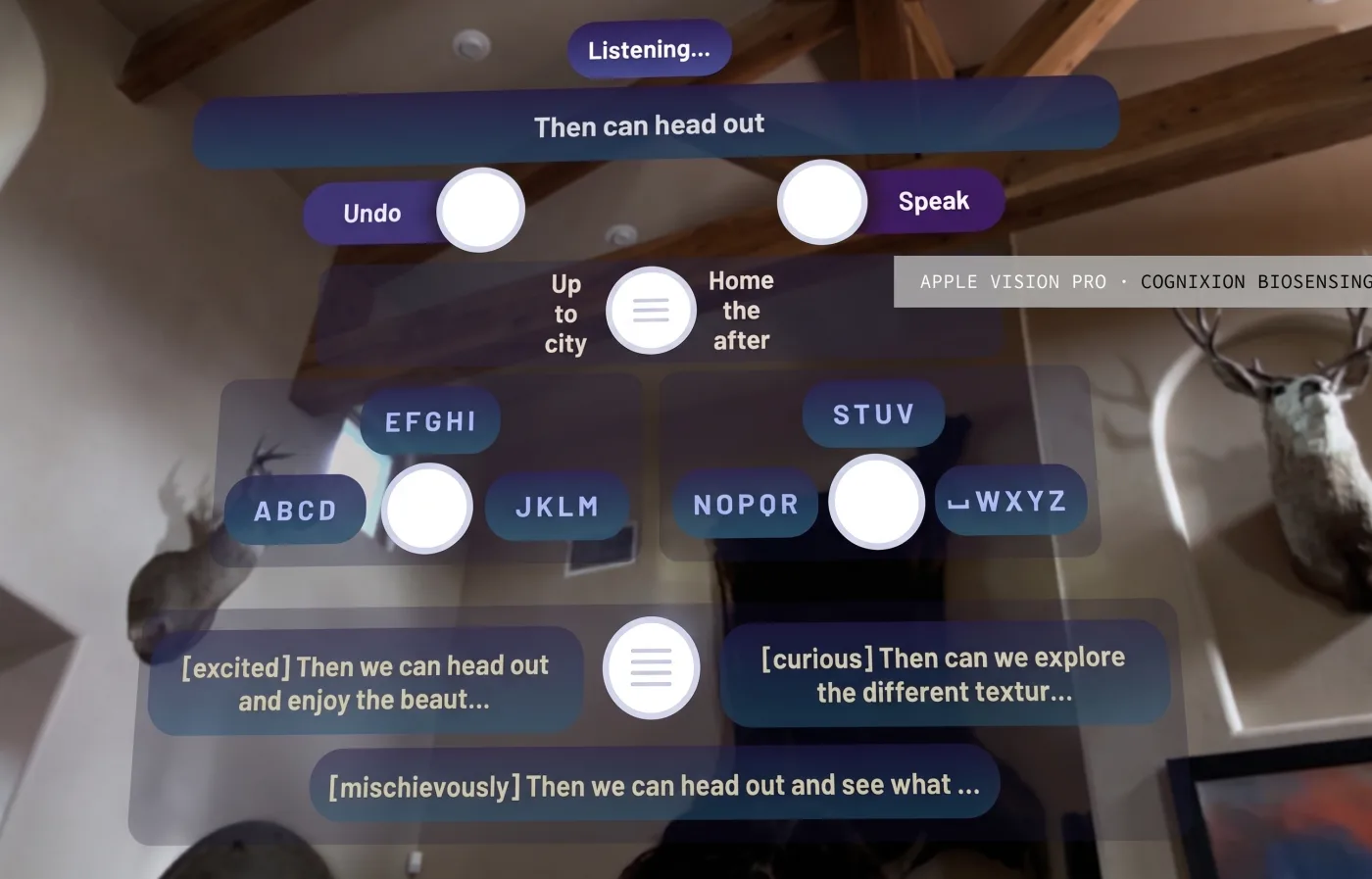
The communication interface rendered through the Vision Pro’s passthrough display, floating in the participant’s own living room. Each white circle is a selection target. Letters are reached in groups, then drilled into. Participants most often asked us to replace that step with a full keyboard. Along the bottom, the language model offers the same sentence in three registers, tagged by tone.
How it works
The computing device was an Apple Vision Pro with three things added to it: the Axon-R, Cognixion’s medical-grade EEG sensing module; an Open Face Comfort System that holds the headset without covering the wearer’s eyes from the side; and our communication software, which uses an AI enhanced personalized language model to suggest what someone might want to say.
It works by showing the wearer a set of targets that flicker, each with a unique visual pattern. When you pay attention to one of them, your visual cortex starts responding at that same rhythm, and the EEG sensors pick it up. The system reads which target you were attending to, and that becomes a selection: a letter, a word, a whole phrase.
Participants could drive the system three ways: with the brain signal alone, with a hybrid of eye tracking and brain signal, or with eye-tracking dwell.
The software runs as native visionOS apps. The interface floats in the wearer’s own room on the headset’s passthrough display, and the hybrid mode pairs the Vision Pro’s built-in eye tracking with the Dwell Control accessibility feature in visionOS. Throughout the study we shipped new builds to participants’ headsets through Apple’s TestFlight, often installed by the caregiver while we guided them over video.
The language model adapts to the person and the moment. It draws on a profile of each participant (family, hobbies, and samples of their past writing) and on the conversation in progress. When D004’s friends visited, it surfaced suggestions about camping and RV trips, drawn from his profile. Suggestion quality tracked the profile closely, and participants asked for an easier way to keep theirs current.
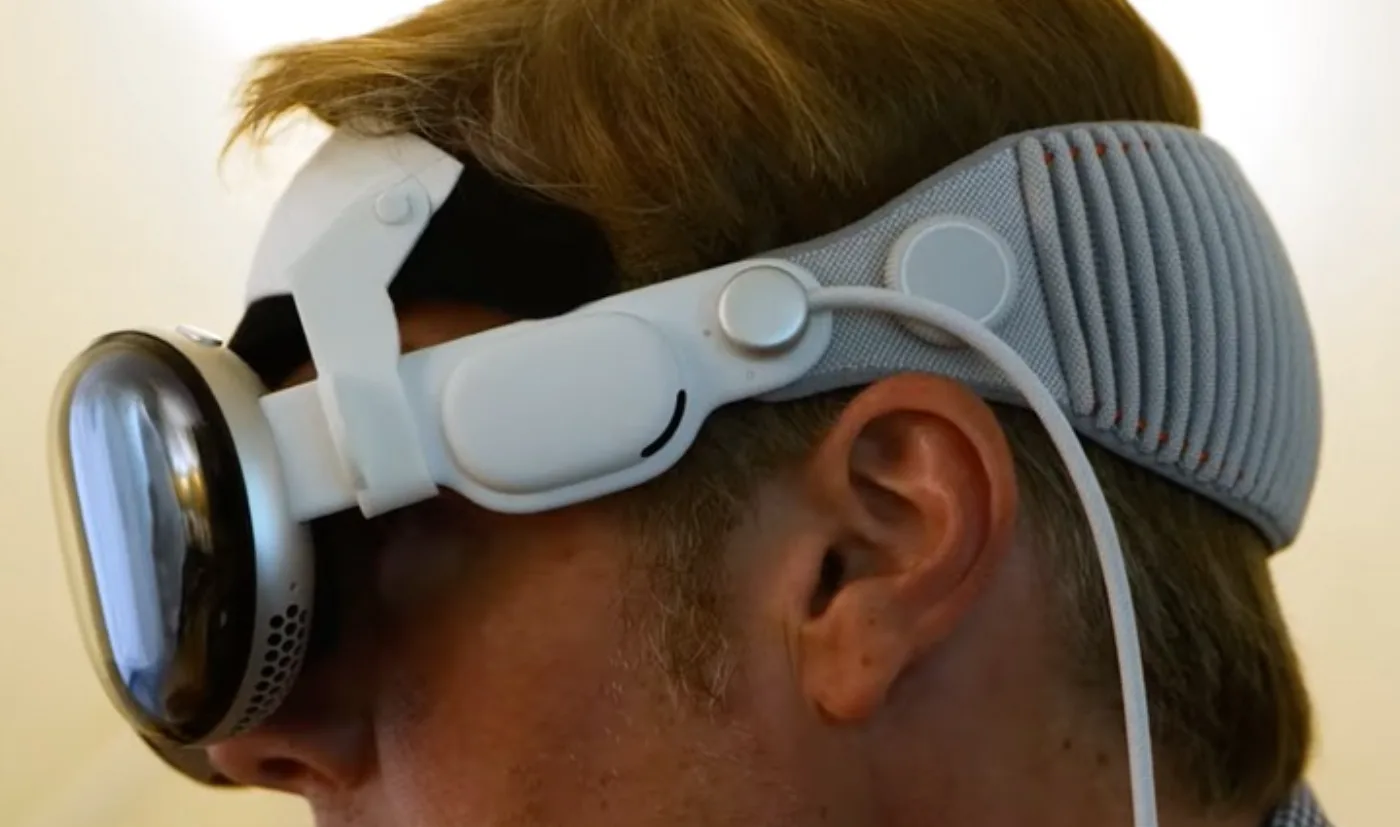
The Open Face Comfort System holds the headset and the Axon-R sensors in place while leaving the wearer’s eyes visible from the side, which participants and caregivers both told us mattered socially as well as clinically.
Study design
Four participants enrolled between November and December 2025: three living with ALS, one with chronic stroke sequelae going back about twenty years. They are identified here by their study codes, D001 through D004. Sessions ran from January through April 2026, and the study closed in May.
The design is the part worth dwelling on. Our team visited each participant’s home once for about 3 hours, to deliver the device and train the family member or caregiver who would be running it. After that, everything happened in the house, operated by that caregiver, with Cognixion staff joining by video call about once a week.
Every session in this study (all 146 brain-computer interface sessions and 40 communication sessions analyzed) happened at home, where the participant actually lives, run by someone who loves them.
That is a harder test than a laboratory, and it is the test that matters. A communication device has to work after the engineers leave.
Results
The headline result is that the accuracy ceiling was reachable for everyone. Every participant hit at least 84% accuracy in their best session. One reached 100%. Another reached 94%. These are four people with significant motor and speech disability, using a wearable, non-invasive system at their own kitchen tables. It requires no surgery.
| Participant | Best BCI accuracy |
Best ITR bits/min |
Median WPM |
Best WPM |
Before the study, WPM |
|---|---|---|---|---|---|
| D001ALS | 84% | 23.9 | 4.2 | 18.9 | 3–8Partner letterboard |
| D002Chronic stroke | 94% | 40.3 | 15.9 | 48.8 | ~23Expert-partner letterboard |
| D003ALS, late stage | 100% | 30.8 | 2.1 | 15.8 | ~2Caregiver alphabet scan |
| D004ALS, late stage | 88% | 33.1 | 12.3 | 20.6 | 4.5Tobii eye tracker |
The fastest session in the study reached 48.8 words per minute. Averaged across the four participants, best sessions ran at 26 words per minute and median sessions at 8.6. The last column shows how each person communicated before the study. Measured against that method, best-session speed was about 8 times faster for D003, 4.6 times faster for D004, and 2 to 6 times faster for D001. D002’s letterboard, run by an expert partner, outpaces his median session on our system, though it depends on that partner being in the room. Over the study, the four participants composed and spoke 3,766 words across 347 utterances.
Across all 186 sessions, in four private homes over five months, there were no serious adverse events. One participant reported mild pressure discomfort on the forehead and nose from the headset interface, which we resolved by adding foam padding to the comfort system. A family member can take the system off at the end of a session and put it back on the next morning.
Information transfer rates between 24 and 40 bits per minute sit within the range published for research-grade systems of this type, which is notable mostly because those benchmarks come from laboratory setups.
The more interesting finding is that people got better. We analyzed each participant’s first fourteen sessions for trend, and two of the four show statistically significant within-participant learning across accuracy, transfer rate, and selection time (p < 0.05 on at least two of the three). D002 improved accuracy by 62% and cut selection time by more than half. D004 cut selection time by 76%.
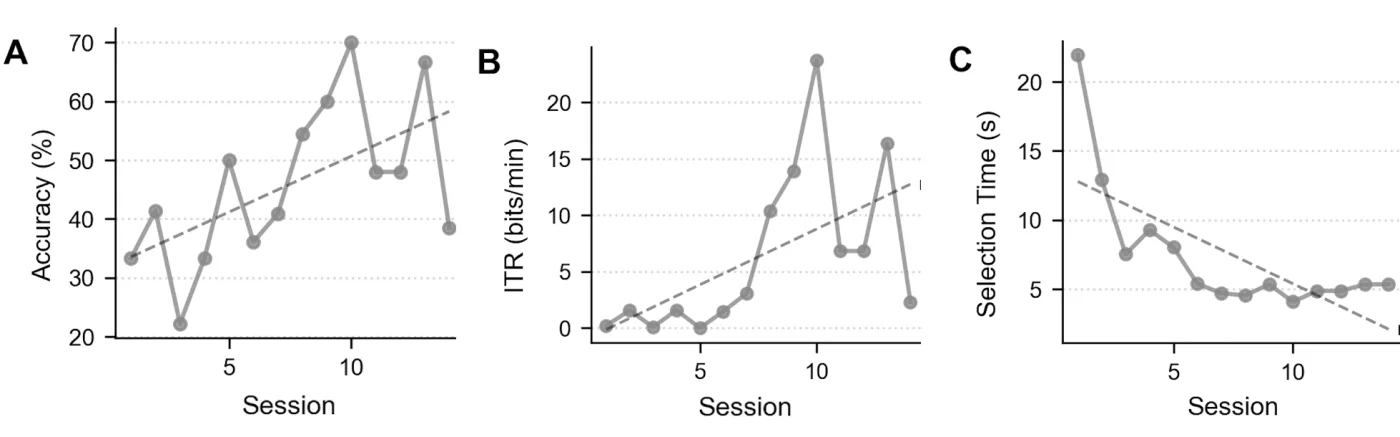
One of the two participants with significant learning: D004’s first fourteen sessions. (A) classification accuracy, (B) information transfer rate, (C) selection time. Each point is one session; dashed lines are least-squares trends. Selection time is the cleanest signal: 22 seconds down to about 5, then flat.
The other two improved too, in a way that trend lines alone miss. If you compare each person’s first three sessions against their last three and ask how cleanly the system could tell their intended target from the others, the answer improves across the board: from 69% to 81% for one participant, 82% to 90% for another, and 28% to 61% for the third. Across the whole group, average selection time fell significantly over the study (p = 0.001).
On throughput, the spread is wide and reflects both individual capabilities and the variance induced by ALS itself. D002 reached a median of about 16 words per minute on the brain-driven keyboard and peaked near 49, comparable to their own sessions on a standard keyboard, and the clearest evidence in the study that this is a real input device. D004 reached a median around 12 words per minute across all sessions, and closer to 18 on the hybrid keyboard specifically, against a measured baseline of 4.5 on the eye tracker they had been using. The other two used the system actively but more slowly, which looks less like typing and more like careful, deliberate assistive communication.
One result stands apart from the trend lines. Early in the study, D001 had been stuck at an information transfer rate of about 10 bits per minute on a previous version of the Axon-R platform. Within four weeks on the integrated Vision Pro system, they went from 5.5 to 15.9, breaking through a ceiling the earlier hardware could not get past.
Limitations
This study was built to answer one question: can the system be delivered into a home and operated there for months by the people who live in it, without us in the room. Four participants is enough to answer that. The answer is yes.
Four participants is not enough to establish how well it works, for whom, or how much better it is than what someone already owns. The trends above are within-participant, across a handful of sessions each. They are not a controlled comparison and are not powered to be one. Our cohort was three people with ALS and one with chronic stroke; spinal cord injury and chronic brain injury were target indications we did not reach. Sessions ran at roughly a third of the cadence the protocol asked for, paced by health, travel, and family life rather than by a training schedule. Those are the questions and conditions the next study is designed for. Full results will be posted to the study’s ClinicalTrials.gov record.
Case study: D004
D004, the one with the visiting friends, came into this study with essentially no usable communication throughput. His Tobii eye tracker, which we measured over a ten-minute baseline, ran at about 4.5 words per minute. His own description of it was that it was tedious.
His first day on our system, in mid-December, produced accuracy between 22% and 50% across five calibration rounds. The session three days later was worse in one specific way: the room was too bright, and he could not see the flickering targets clearly. He finished at 37.5%. The problem was the lighting.
Two days after that, his wife set up the screen mirroring before we arrived on the call. The setup took minutes instead of an hour, which left the whole session for actual practice. He hit 75% in the first round and 87.5% in the second.
What followed over the next two months is the part that changed how we think about this technology. It was the story of two systems, human and technology, adjusting to each other.
In early January we moved the targets, because his comfortable vertical eye range was narrower than our default layout assumed. He hit 100% that session. A few days later we shrank the targets for a side test and watched accuracy drop to 75%, which told us the earlier change had been right. Later that month, one target sitting at 12 Hz kept giving him trouble, so we cycled through 7, 7.5, 8, and 9 Hz within a single session until we found frequencies his visual system liked better. By the end of January he was using a new diamond-shaped layout and hitting 100% again. His verdict: “New device is a lot better, more accurate.”
His feedback changed character around then, too. It stopped being about whether the interface worked and started being about what he wanted from it: move the speak button lower, give me more current sports information, let me force-quit a stuck app. Those are the notes of someone who has stopped evaluating a prototype and started using a tool.
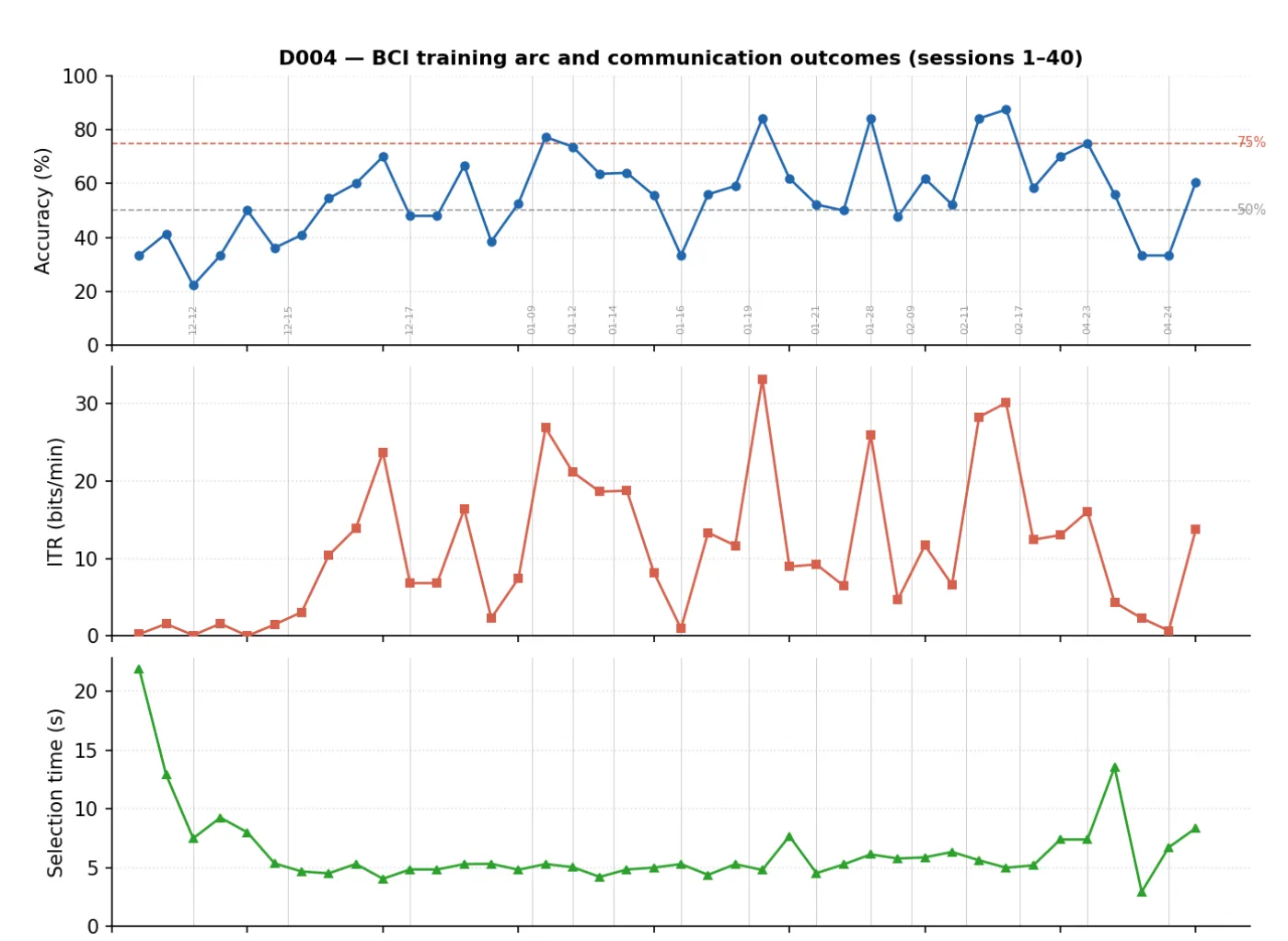
D004 across all 40 sessions, December to April. Selection time (green) drops from 22 seconds to about 5 within the first ten sessions and stays there for five months. The long gap before the late-April gridlines is a two-month break; accuracy dips on return, though even the lowest April sessions sit above the December baseline.
February was the peak. On the eleventh he recorded 20.6 words per minute, more than four times his eye-tracker baseline. Two days later the session notes record a conversation that “went well with lots of back and forth,” during which he asked us about how the system’s tone feature worked and how current the language model’s knowledge was. On the seventeenth he hit 87.5% accuracy (roughly seven of every eight selections correct), with selection times settled around five seconds, down from more than twenty in December.
One detail in his data surprised us. In his first communication session, he used about 1.3 keyboard interactions per phrase; he was picking whole pre-written phrases and speaking them. By February, at his highest word rate, that number had climbed to 12.1. He was building sentences word by word instead of choosing from a menu. More effort per phrase, and more words per minute at the same time. He was saying more specific things, with the AI helping him build each sentence.
Which brings us back to the living room, and the friends who came to visit, and the fact that we were not there.
Individual differences
Here is the thing we suspected before the study and can now show: each person needs their own configuration of this technology.
D003 can only reliably use four targets, arranged as a diamond or a 2×2 grid. Push to six or more, in any layout, and his accuracy collapses. He performs best with the keyboard at 0.8 meters, with 0.65 being too close to read comfortably, and 1.0 being too far.
D004 works well at six targets once we lowered the whole interface to match a vertical eye range narrower than our default assumed, and swapped 12 Hz, a frequency his visual cortex struggled to lock onto, for a set built from 7, 7.5, 8, and 9 Hz.
D001 ended the study on an eight-target dwell keyboard, the configuration that finally fit him after months of iteration.
The differences go past the hardware. Asked to compose a sentence, one participant took the AI’s suggested phrasing 42% of the time; another took it 5% of the time and typed almost everything letter by letter. The first averaged 16 words a minute, the second under 5, but the second produced the most lexically varied speech in the study. The different approaches here reflect individuals’ unique communication styles and show how the system can support their preferences.
Accessibility Settings Must Evolve Into Dynamic Personalization. AI will play a big role in marrying up biometric data and context awareness to aid in truly bionic mind driven experiences.
Chris Ullrich, CTO, Cognixion · Principal Investigator
Each of the four participants finished the study on a different configuration, with its own combination of target count, layout, frequencies, and way of building a sentence. If we had shipped just one configuration as the product, it would have failed the other three participants.
The hardest question in the study
Why BCI?
D002 is technically literate, demanding, and has good control of his eyes. He produced the strongest performance numbers in the study. He also asked us the hardest question in it, more or less directly: what is the brain-computer interface actually for, if I can move my eyes and use dwell?
He was reporting his experience honestly (“Why would you use BCI if you have eye tracking with dwell?”): for him, the EEG added setup time without adding capability.
It turns out that dwell competes with eye tracking. It’s essentially an “opt-out” interaction. When using dwell, users need to first read the text and then, quickly, opt in or out of selecting it. Typical dwell times are 1.2s (this is the Tobii default), which means that if the user doesn’t look away within 1.2s, the item they’re looking at will get selected automatically. In practice, this is anxiety inducing and a key reason that many persons with speech devices use a switch controller.
When we replaced dwell with BCI, the “opt-out” flipped to “opt-in”: users need to consciously decide to fixate on what they’re looking at in order to select. This reduces anxiety and makes the interaction significantly more pleasing.
For persons with late stage ALS, eye tracking may not even be an option. D003 has late-stage ALS and very limited eye movement. He cannot reliably reach targets in the upper corners of a display at all. Before the study, he communicated by having a caregiver recite the alphabet while he signaled the right letter with a small eye movement, at about two words per minute, one sentence per 10 minutes. Eye tracking alone was never going to be his input method.
He logged 52 brain-computer interface sessions, more than anyone else in the study, and produced 1,431 words, also more than anyone else. His best session hit 100% accuracy, and his fastest reached 15.8 words per minute, about eight times the pace of the alphabet scan. His average utterance ran nearly 19 words long, and 59% of what he said was scored as positive in tone, the highest in the cohort. He used the system to connect more deeply with his son by discussing sports.
So both things are true, and they define who this technology is for. If you have workable eye control, the brain-computer interface is one capability among several, and our job is to make the software around it excellent. If you do not, it is the only door. For people in the second group, there is currently no eye-tracking product on the market that can do what this did.
This is the case for sensor fusion rather than sensor choice. Eye tracking failed one of our four participants completely. EEG added setup burden for another without buying him anything. A third did best with both together, and a fourth with neither: just dwell, tuned patiently. Serving all four took the full set of input methods, combined differently for each person.
The platform has to carry all of them and select per user. That is the requirement the study handed us.
Cognixion is rapidly transforming the definition of I/O from Input/Output toward Intention/Outcome.
Andreas Forsland, Founder and CEO, Cognixion
That is the platform we are building.
Thank you
One more finding sits underneath all of the above. Every session in this study depended on a family member who had been trained for about three hours and then left to it. Setup took 45 minutes at the start and 10 to 15 by the end, and one caregiver told us plainly where the real bar is: if it can’t be set up in five minutes, it won’t be used. A platform that adapts to every user has to be one the person setting it up each morning can manage. Simplifying setup is the gate on everything else.
Four people gave us five months of their time, in their homes, during a period of their lives when time is the least abundant thing they have. Four caregivers (spouses and family members) learned an unfamiliar system, set it up week after week, and told us plainly when it was too hard. Every improvement we made came from them.
We are continuing this work in a longitudinal study for people with late-stage ALS, and expanding to new clinical sites. If you or someone you care for lives with ALS, spinal cord injury, or chronic brain injury, and you want to hear about future Cognixion studies, you can email us.
The Cognixion Pass Through Study (COG-PTS-002) is registered at ClinicalTrials.gov as NCT07209943, where full study results will be posted.
The Cognixion + Apple Vision Pro system is an investigational device. It is not approved or cleared by the FDA, is not available for sale, and its safety and effectiveness have not been established. Participation in a Cognixion clinical study does not guarantee any benefit.
Apple and Apple Vision Pro are trademarks of Apple Inc. Cognixion is not affiliated with or endorsed by Apple Inc.