
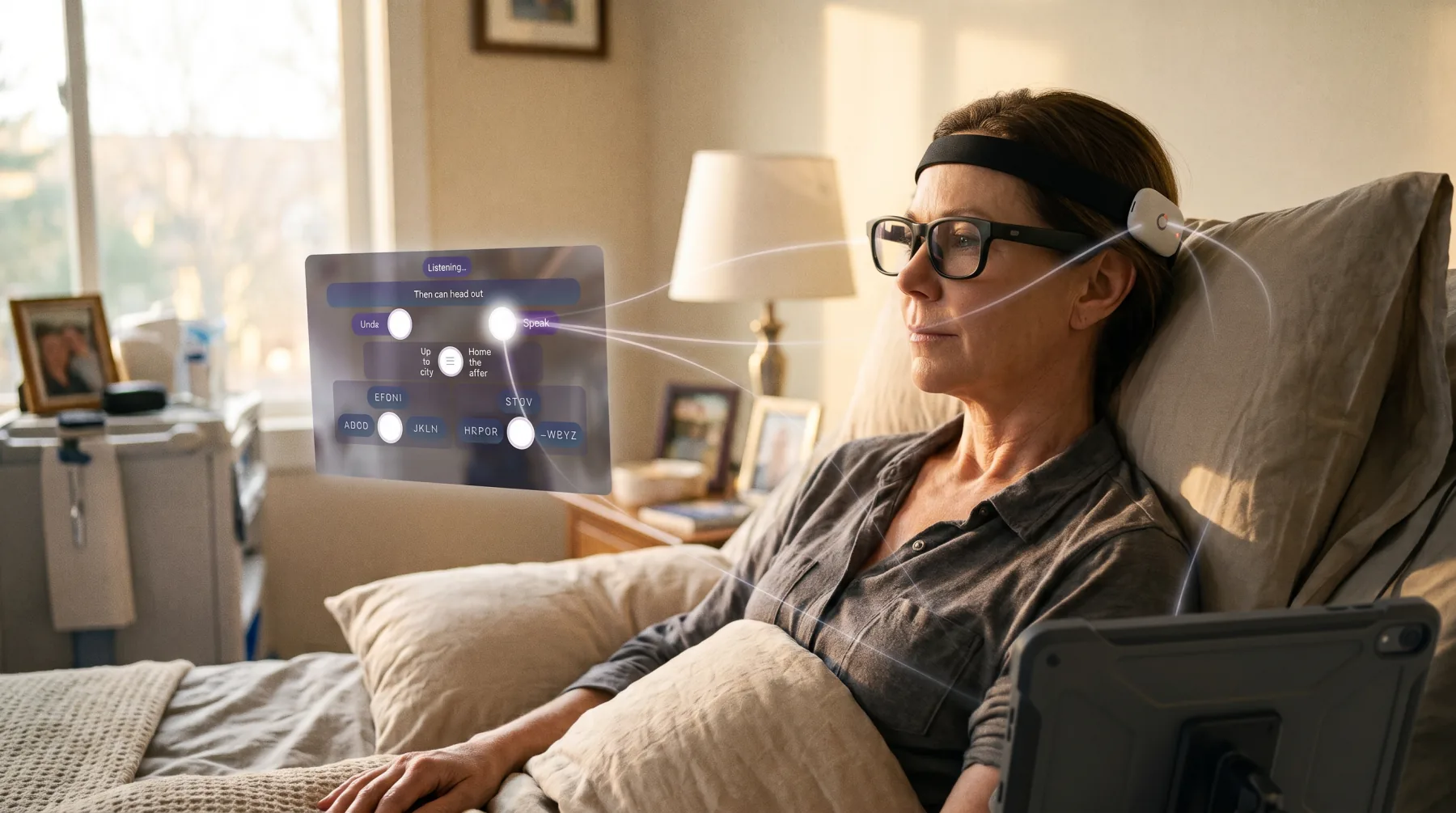
For people living with amyotrophic lateral sclerosis (ALS), communication can become increasingly challenging as the disease progresses. As the ability to speak and move becomes limited, assistive communication technologies can provide an essential connection to loved ones, caregivers, and the world around them.
Eye-tracking communication devices have become an important tool for many people with ALS, enabling individuals to communicate using their eye movements. But as physical abilities and communication needs change, researchers are exploring additional ways to support communication and personal independence.
What if the future of assistive communication offered people more ways to interact, and more choice in how they communicate?
That question is central to Cognixion’s newly launched CHOICE Study, an NIH-funded clinical research study that will include adults living with ALS across the United States.
The study will investigate how Cognixion’s wearable, non-invasive brain–computer interface (BCI) technology compares with the eye-tracking communication devices participants already use, bringing emerging neurotechnology research into the home.
Exploring What’s Next in Assistive Communication
For decades, assistive communication technology has helped people with significant speech and motor disabilities express themselves and participate more fully in everyday life.
Today, advances in brain–computer interfaces, artificial intelligence, and augmented reality are opening new areas of research into how people may interact with technology.
Cognixion is developing an approach that brings several of these technologies together in a wearable communication system.
The investigational Cognixion ONE combines:
- Non-invasive brain–computer interface technology: Wearable brain sensing designed to support interaction without surgically implanted components.
- Assisted Reality communication app: AI suggests words and phrases, personalized to the user. The user chooses, edits or ignores each suggestion, and nothing is spoken unless the user selects it.
- Augmented reality display: Lightweight see-through glasses for most participants, or a closed headset where that suits a participant better.
- Eye tracking, in some configurations: Can be combined with brain sensing to make selections.
Cognixion ONE supports more than one way to make a selection, including brain signals alone.
The CHOICE Study will help researchers better understand how this investigational technology performs alongside established communication tools in real-world settings.
Why the CHOICE Study Is Different
The CHOICE Study is a longitudinal clinical study comparing Cognixion’s investigational BCI technology with the eye-tracking communication devices people with ALS already use.
Supported by the National Institute on Deafness and Other Communication Disorders (NIDCD) of the National Institutes of Health (NIH), the study plans to enroll 30 adults with ALS across the United States.
Rather than evaluating a new device in isolation, the research examines how participants use and choose among different communication technologies.
Over 12 weeks, participants will use three communication options:
- Their existing eye-tracking device: A familiar tablet-based speech-generating device, such as a Tobii Dynavox or Smartbox system.
- A head-worn Cognixion BCI: The investigational system with an augmented reality display.
- A screen-based Cognixion BCI: The same brain–computer interface, with the display on a monitor or tablet instead of a head-worn display.
For some sessions, participants are asked to use a specific option. For others, they choose whichever option they prefer. The primary outcome measure is how much time participants voluntarily spend using each option.
This participant-centered approach is an important part of the research. Beyond technical performance, the study seeks to understand which technologies individuals choose when multiple communication options are available.
Researchers will also evaluate communication speed and accuracy, usability, workload, quality of life, and caregiver burden.
Together, these measures may provide insights into how future assistive communication technologies can better respond to the needs and preferences of the people who use them.
Putting Independence and Agency at the Center of Innovation
At Cognixion, our work is driven by the belief that communication is fundamental to personal independence, dignity, and agency.
As ALS progresses, the loss of physical abilities can make everyday interactions increasingly difficult, not only for individuals living with the disease but also for the caregivers and loved ones supporting them.
Our research explores how emerging technologies might expand the ways people interact with their environments and participate in decisions affecting their daily lives.
As Chris Ullrich, Chief Technology Officer at Cognixion and Principal Investigator of the CHOICE Study, explains:
“Communication device studies usually measure speed and accuracy in a session. This study asks a different question: with three options at home for 12 weeks, which one does a person actually choose to use? That choice is the most direct measure we have of what works for them.”
The CHOICE Study represents another step toward understanding the potential of integrated brain sensing and artificial intelligence in assistive communication.
Just as importantly, it creates an opportunity for people living with ALS to contribute their experiences and preferences directly to the research process.
Their participation will help inform the continued investigation and development of emerging communication technologies.
Bringing BCI Research Into the Home
An important aspect of the CHOICE Study is that participation takes place in the individual’s own home.
For people living with ALS, traveling to research facilities can present practical challenges. The study’s at-home design allows participants to engage with the technology in a familiar environment, supported by their caregivers and the Cognixion research team.
Over about 12 weeks, participants use the devices in sessions of about an hour, 3 to 5 times a week, with a trained caregiver present.
The Cognixion study team provides equipment setup, caregiver training, and regular check-ins throughout participation.
By studying these technologies in participants’ homes, researchers can gather information about their use in everyday environments, including individual preferences and the experience of caregivers.
Study details, including eligibility, are listed on ClinicalTrials.gov under NCT07871071.
Important Study Information
The Cognixion BCI evaluated in the CHOICE Study is an investigational device. It is not approved or cleared by the U.S. Food and Drug Administration for any medical use, and there is no guarantee that anyone participating will benefit. There are risks, including discomfort from wearing the device, skin irritation, and fatigue. Participation is voluntary, participants may stop at any time, and regular ALS care continues unchanged.
Research reported here is supported by the National Institute on Deafness and Other Communication Disorders of the National Institutes of Health under Award Number R44DC023888. The content is solely the responsibility of the authors and does not necessarily represent the official views of the National Institutes of Health. This project is 100% funded by federal funds from NIDCD, totaling $1,258,551 for the first budget year.